
What Happens If an Heir Refuses to Sell the Home? Guide to Resolving Disagreements
Inheriting a home can be both a blessing and a source of conflict, especially when there is no agreement among the heirs about what to do with the property. In many cases, one or more heirs want to sell the property, while others refuse, which can lead to tense and complicated situations. In this article, we will explore what happens when an heir refuses to sell the home, how to handle disagreements, and what legal options exist to resolve the situation.

Disagreement on the Sale of an Inherited Home: Common Causes
When several heirs inherit a property, differences of opinion about what to do with the property are common. Some of the reasons why an heir may refuse to sell the home include:
- emotional bond: Some heirs may have a strong emotional attachment to the home, especially if it was the family residence for many years.
- personal use: An heir may be living in the property and prefer to continue doing so rather than sell it.
- Financial expectations: There may be disagreements about the value of the home or when is the best time to sell, depending on real estate market conditions.
- Lack of economic need: If an heir does not need the money from the sale, they may not feel the urgency to sell.
- Desire to rent: Instead of selling, an heir might prefer to rent the property for continued income.
What happens if there is no agreement between heirs?
When heirs cannot agree on the sale of a home, a series of legal and financial complications can arise. The main consequences are detailed below:
1. Immobilization of Property
If there is no agreement, the inherited home may remain in limbo, unable to be sold, rented or distributed. This can lead to unnecessary expenses, such as paying property taxes, maintenance, and other associated costs.
2. Deterioration of Family Relationships
Disagreements over the sale of property can lead to family tensions and conflicts, deteriorating relationships between heirs. This is especially likely if negotiations drag on without reaching a resolution.
3. Loss of Property Value
In some cases, a delay in selling the home can result in a loss of value, especially if the housing market experiences a downturn or if the property deteriorates due to lack of proper maintenance.
4. Legal Intervention
If the heirs cannot reach an agreement, one of them may decide to take the case to court. This process, known as judicial division of inheritance, can be expensive and lengthy, and often results in the property being auctioned, which may not be the most profitable option.
Legal Options to Resolve Disagreements in the Sale of an Inherited Home
If the heirs cannot reach an amicable agreement, there are several legal avenues to resolve the conflict. Below, we explore the main options:
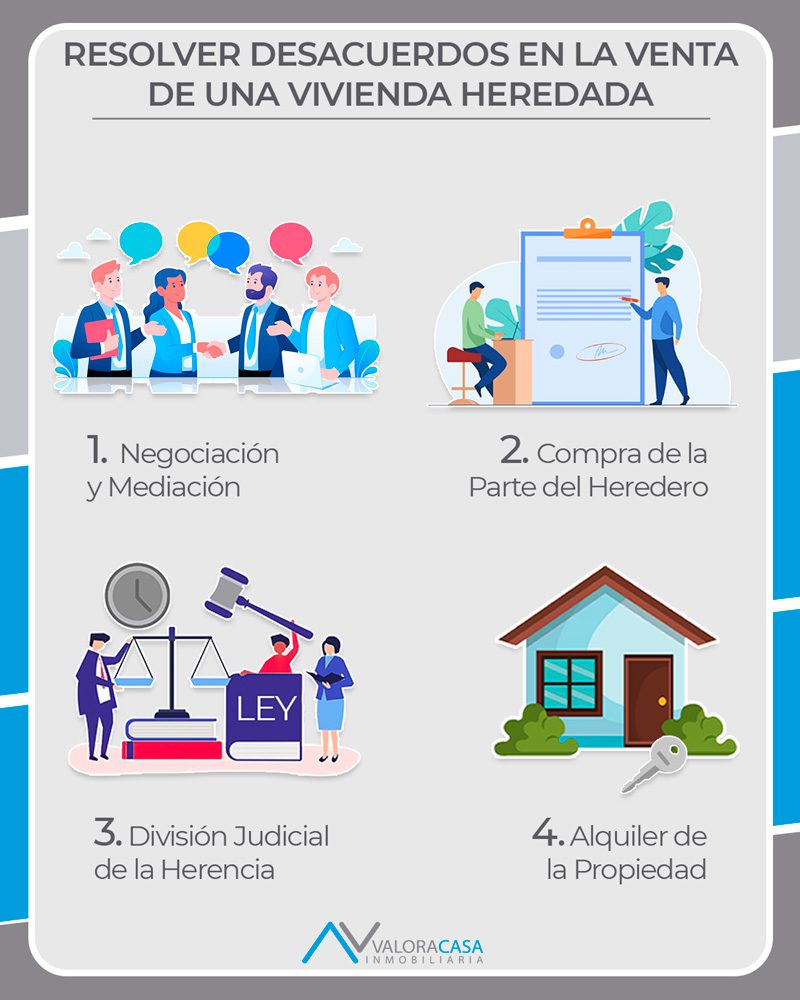
1. Negotiation and Mediation
The negotiation It is the first recommended step to resolve any disagreement between heirs. In many cases, an open and honest conversation can help find a compromise that satisfies all parties. If direct conversations do not work, you can consider mediation, in which a neutral mediator helps the heirs reach an agreement.
2. Purchase of the Heir's Share
If one or more heirs want to keep the property and others prefer to sell, it is possible for those who want to keep the home to buy out those who want to sell. This agreement can be a quick and satisfactory solution for all parties.
3. Judicial Division of Inheritance
When an agreement cannot be reached, any heir can request the judicial division of inheritance. In this case, a judge will intervene to distribute the property or, more commonly, order the sale of the home and the subsequent distribution of the money obtained among the heirs. This process can be expensive, involving legal fees and, in some cases, a public auction that may not achieve the best selling price.
4. Property Rental
Another option is for the heirs to agree to rent the property, rather than sell it, and share the proceeds among everyone. This option may be attractive if the value of the property is expected to increase over time or if the heirs have no urgency in receiving the money.
Advantages and Disadvantages of Each Option
Negotiation and Mediation
- Advantage: It is a quick and amicable solution, avoids legal costs and preserves family relationships.
- Disadvantages: It may not be effective if the positions of the heirs are very polarized.
Purchase of the Heir's Share
- Advantage: Resolves the conflict definitively, allowing the heirs with the greatest attachment to the property to keep it.
- Disadvantages: Requires that the purchasing heir have the financial resources to acquire the share of others.
Judicial Division of Inheritance
- Advantage: It is a legally binding and definitive solution, even in cases of serious disagreements.
- Disadvantages: It is expensive, may be slow, and the result (a public auction) may not be financially favorable to the heirs.
Property Rental
- Advantage: Generates continuous income, allows you to postpone the sale decision until market conditions are favorable.
- Disadvantages: Requires heirs to jointly manage the property, which can be complicated if there are already disagreements.
Conclusion: The Importance of the Agreement between Heirs
Resolving disagreements over the sale of an inherited home requires patience, communication and, in many cases, legal advice. Although differences of opinion are common, it is essential to find a agreement that satisfies all parties, thus avoiding long judicial processes and family conflicts.
The best strategy is to approach the issue openly from the beginning, exploring all available options and considering both emotional and financial aspects. Although negotiation and mediation are the quickest and least conflictive solutions, in some cases it may be necessary to resort to judicial intervention to resolve the conflict definitively.
Regardless of the option they choose, the most important thing is that heirs work together to find a solution that allows for a fair distribution of the inheritance, minimizing the stress and tensions that often accompany these processes.
Contact